
Advertisements
Staring at a massive blank white wall makes your apartment feel completely sterile and unfinished. Most property managers write aggressive clauses into your lease strictly forbidding heavy hardware. The fear of losing a two-thousand-dollar security deposit keeps many renters completely paralyzed. Figuring out how to hang things on walls without drilling solves this massive design headache permanently.
I spent my first year in my Capitol Hill studio staring at bare drywall because I owned exactly zero power tools. Eventually, I discovered highly effective methods to mount heavy frames and floating shelves using damage-free products. You can absolutely create a beautiful home filled with art without destroying the property.
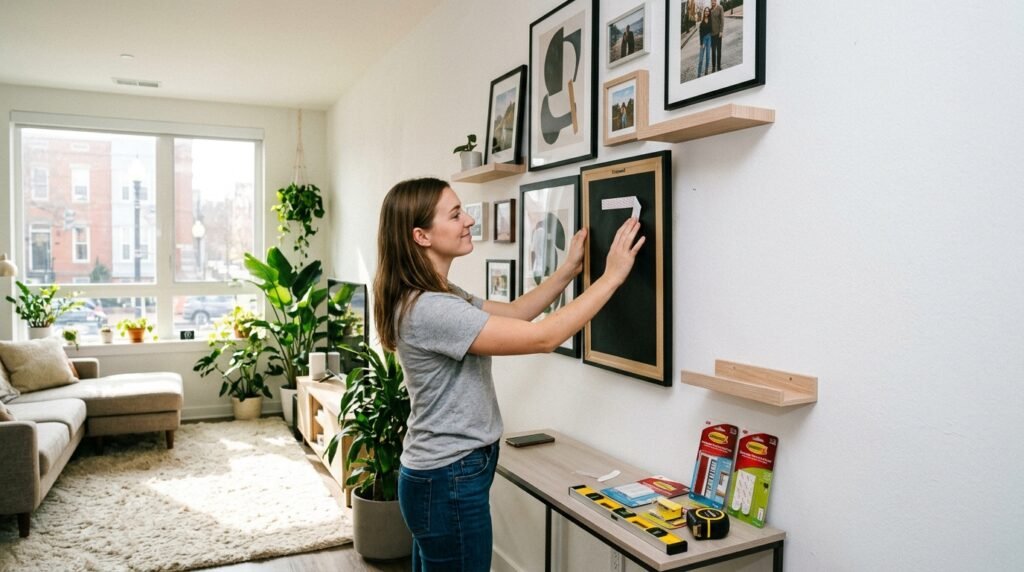
Step 1: Prep your drywall surface correctly
A dusty apartment wall instantly ruins the chemical bond of any commercial adhesive product. You cannot just slap a sticky strip onto dirty drywall and expect it to hold a heavy wooden frame. Invisible layers of cooking grease and daily dust prevent the glue from gripping the paint properly.
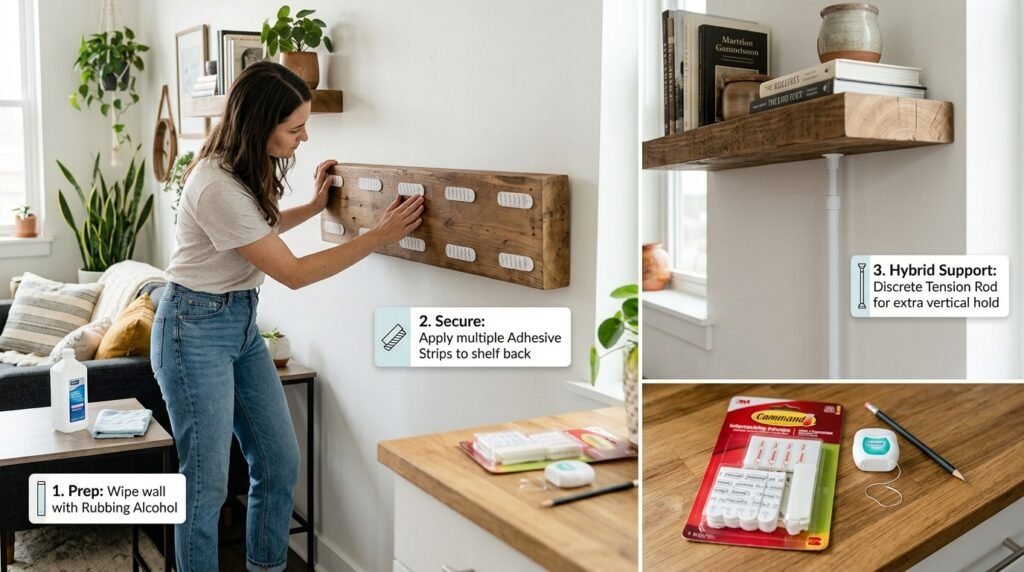
You must wipe the entire target area down with rubbing alcohol before you apply any sticky product. Isopropyl alcohol evaporates in seconds and leaves absolutely no soapy residue behind. It cleans the exact spot perfectly and guarantees a rock-solid hold for years.
Never use standard household window cleaners or soapy sponges for this specific task. Those liquid products leave a slippery film that actively fights against the adhesive materials. Preparing the drywall correctly gives you the confidence to hang things on walls without drilling safely.
Anúncios
Understanding weight limits and humidity
Heavy canvas paintings will inevitably crash to the floor if you ignore the printed weight limits. Every box of adhesive strips specifically states exactly how many pounds the product holds. You must weigh your actual picture frame on a digital kitchen scale before you buy the hardware.
Humidity also plays a massive role in how well these sticky products perform over time. A steamy rental bathroom quickly weakens standard adhesive glue and causes heavy mirrors to slip. You must buy specialized water-resistant strips specifically designed for humid environments.
Learning these simple rules perfectly complements how to create a gallery wall with removable hooks. Taking a few minutes to read the packaging prevents shattered glass and ruined artwork.
Step 2: Use interlocking strips to hang things on walls without drilling
Traditional sticky hooks protrude far from the wall and make flat picture frames tilt awkwardly forward. You need a solution that keeps the wooden frame completely flush against the drywall. Interlocking hook-and-loop strips provide the absolute best method to secure flat objects invisibly.
These thick adhesive strips snap together loudly to lock your artwork firmly in place. You apply one sticky side directly to the frame and the other side straight onto the cleaned wall. This method completely removes the terrifying guesswork of finding a wooden wall stud.
I use the large Command brand picture hanging strips exclusively for my thrifted art collection. They cost roughly twelve dollars for a massive pack at Target and save me endless installation frustration. Finding reliable mounting strips makes it incredibly easy to hang things on walls without drilling inside an awkward space.
The clever dental floss removal trick
Removing stubborn adhesive strips sometimes rips the top layer of cheap apartment paint right off. You pull the little plastic tab too quickly and suddenly you have a massive white patch to fix. There is a highly specific trick to prevent this exact nightmare.
Grab a long piece of standard waxed dental floss and wrap it tightly around both of your hands. Slide the tight string directly behind the sticky pad and pull it slowly downward. The wax cuts right through the foam adhesive backing without touching the fragile paint job.
According to experts at Apartment Therapy, applying a little heat from a hairdryer also softens the old glue beautifully. Combining the warm air with the dental floss makes removal completely stress-free when your lease finally ends.
Step 3: Rely on tension rods for temporary support
Renters often forget that window frames and narrow hallways offer built-in structural support. You can wedge a heavy metal pole between two solid surfaces to create an instant hanging rail. A thick tension rod uses heavy internal springs to grip the walls tightly.
This completely bypasses the need for metal brackets and permanent mounting hardware. You can easily use a heavy-duty tension rod to hold lightweight floating shelves in a narrow bathroom alcove.
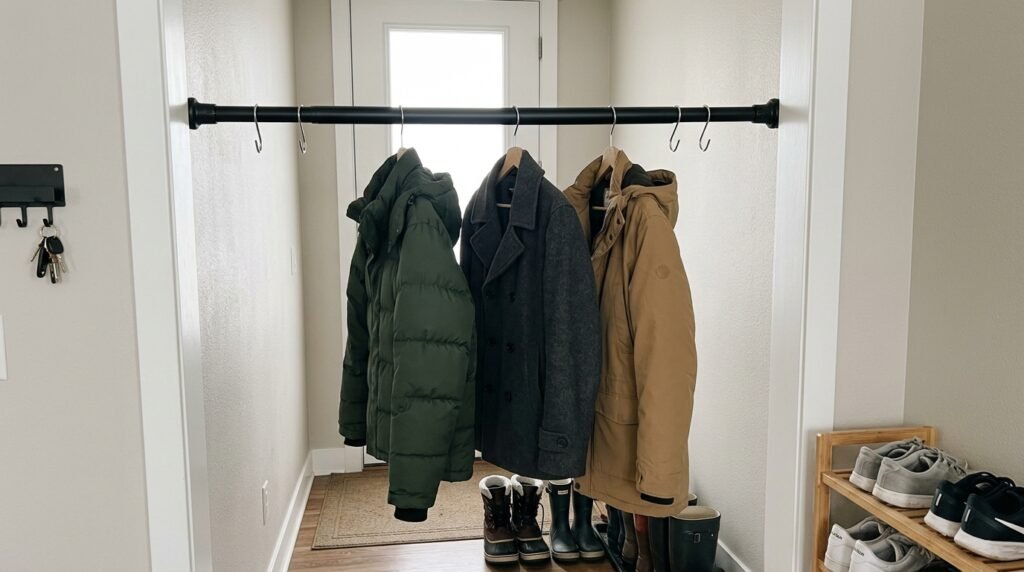
I bought a thick black tension rod on Amazon for eighteen dollars to organize my messy entryway. Wedging it between the closet walls allowed me to use S-hooks to hold all my heavy winter coats.
Supporting light window treatments
You can also use this exact tension method to completely transform your ugly apartment windows. Most property managers install cheap plastic blinds that block all the natural sunlight. You can easily hide them by wedging a thin metal rod directly inside the window casing.
Hang lightweight sheer panels from the temporary rod to soften the harsh plastic blinds underneath. If you want a more custom look, check out how to make cheap curtains look high-end. The sheer fabric adds massive visual warmth to the cold room.
Step 4: Try adhesive nails for framed canvas art
Canvas paintings and wire-backed frames completely fail when you try to use flat interlocking strips. The hollow back of a canvas provides absolutely zero surface area for the sticky pads to grab. You need a product that mimics a traditional metal nail without penetrating the actual drywall.
Adjustable adhesive nails solve this highly specific problem perfectly for renters. These clever plastic gadgets feature a flat sticky back and a tiny metal post that sticks outward. You press the sticky pad to the wall and rest the picture wire directly on the metal post.
The smartest versions actually allow you to slide the metal post up and down after installation. Finding a product that forgives measuring mistakes makes it incredibly easy to hang things on walls without drilling securely. You can level a crooked painting simply by sliding the little plastic notch up a fraction of an inch.
Securing decorative plates and round objects
Round objects like vintage plates or woven baskets look fantastic grouped together in a dining area. They add necessary organic shapes that break up the hard square lines of your furniture. Mounting weird objects requires a slightly different approach than a standard wooden frame.
Buy adhesive plate hangers that feature a sticky circular pad attached to a metal ring. You wet the sticky pad, press it onto the back of your ceramic plate, and let it dry overnight. This creates a permanent loop on the back of the object so you can mount it to your adhesive wall nail safely.
Step 5: Utilize museum putty to hang things on walls without drilling
Tiny decorative details often cause the most annoying installation headaches in a small apartment. You want to mount a lightweight paper calendar or a small unframed poster, but standard hooks look way too bulky. You need a completely invisible product that leaves zero oily residue behind.
Museum putty provides an incredible low-profile grip for highly lightweight items. You pinch a tiny piece of the white clay, roll it into a ball, and press it against your poster. It feels exactly like thick chewing gum but never stains the underlying wall surface.
Interior designers constantly use this specific clay to mount posters and lightweight gallery shows. It works exceptionally well for securing the bottom corners of large frames so they never tilt when you close a heavy door. I keep a cheap pack of Quakehold putty inside my desk drawer at all times.
Stabilizing leaning floor mirrors safely
Massive floor mirrors make a tiny room look twice as large by bouncing the natural sunlight. Unfortunately, leaning a heavy glass mirror against a slick painted wall creates a serious tipping hazard. A heavy truck driving by can rattle the apartment enough to send the glass crashing down.
According to the organizing professionals at The Spruce, placing a thick strip of museum putty behind the top corners anchors the heavy frame firmly to the drywall. The clay absorbs the vibrations and prevents the smooth wood from sliding sideways. Securing your heavy items ensures you know exactly how to decorate a rental apartment without losing your deposit.
Step 6: Combining methods to hang things on walls without drilling
Sometimes a single product fails to secure a particularly heavy or awkward decor piece. You must combine multiple damage-free methods to build a reliable support system. Creating a hybrid approach ensures your most expensive items stay completely safe.
If you want to mount a heavy wooden shelf, use strong adhesive strips across the entire back flat surface. Then, wedge a discrete tension rod underneath the shelf for invisible vertical support. Using multiple techniques to hang things on walls without drilling gives you total peace of mind.
You never have to compromise your design vision just because you rent your living space. Exploring these clever hardware store alternatives allows you to personalize every single square inch of your home.
Wipe your target wall down with rubbing alcohol today and map out your new gallery layout with a pencil. Pick up a bulk pack of interlocking strips and a sharp roll of dental floss before you start mounting your heavy frames. You can finally hang things on walls without drilling and keep your security deposit completely safe.

Fabiana Moura is a decor enthusiast and renter based in Denver, CO. After five moves in eight years, she became obsessed with making small spaces feel like home — without renovation, without a big budget, and without losing the security deposit. At Inovaty, she shares everything she’s learned along the way.